7 Best Acoustic Gypsum Board Suppliers for Global Buyers
Acoustic Gypsum Board is often selected for offices, hotels, schools, and residential projects where speech privacy and room comfort matter. Yet a board alone cannot solve every noise problem. Performance depends on the full assembly: framing, cavity depth, insulation, joints, openings, and installation quality. Small gaps can undermine a carefully specified wall.
The World Health Organization’s Environmental Noise Guidelines for the European Region (2018) recommend reducing average road-traffic noise exposure below 53 dB Lden and nighttime exposure below 45 dB Lnight. These are environmental exposure recommendations, not product ratings. That distinction matters. Buyers should compare tested assembly performance, not assume a board’s name or thickness predicts the result. Ask suppliers for relevant laboratory reports, declared test methods, installation details, and evidence that the proposed system matches the project.
This guide reviews seven suppliers for global buyers, focusing on product documentation, customization, export experience, and technical support. ASTM E90 and ASTM C423 reports may help assess airborne sound transmission and sound absorption, where applicable. Check the tested construction carefully; results cannot always be transferred to a different wall or ceiling design. There is no single best supplier. A strong shortlist should fit the project’s climate, codes, lead time, and budget. And honestly, supplier brochures can make comparisons harder than they should be. Verify the details before you specify.
Acoustic Gypsum Board Basics: Panels, Perforations, and Sound Control
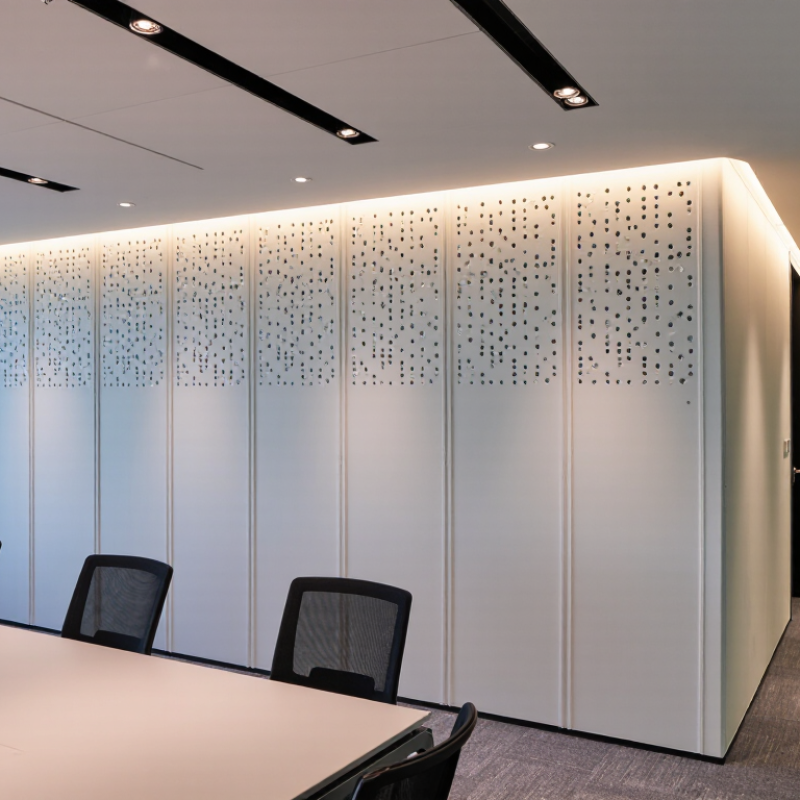
Acoustic gypsum board is a perforated ceiling or wall panel designed to absorb sound within a room. Its small holes or slots let sound reach an absorptive layer behind the board, often a fleece or mineral-wool backing. The gypsum face provides a clean, paintable finish. It does not work alone. The cavity depth, backing material, and installation all affect the result.
Perforations vary in diameter, spacing, and pattern. Small, closely spaced holes create a different appearance from broad slots, but appearance alone cannot predict performance. Ask for test data for the complete assembly, not just the panel. Sound absorption ratings depend on how the board is mounted, including the air gap behind it. Absorption can reduce echo; it does not necessarily block noise passing between rooms. That distinction is easy to miss on a busy project.
Check the panel layout against lights, vents, and access points before installation. Misaligned cuts can interrupt the pattern and leave exposed edges. Also confirm the recommended framing, joint treatment, and finish with the technical documentation. A sample helps assess color and perforation scale, but it cannot prove acoustic performance. Real rooms can behave differently. That is worth remembering.
How Sound Ratings Work: ASTM E90 Testing and ASTM E413 STC Classification
ASTM E90 measures airborne sound transmission loss through a complete wall or floor assembly in a controlled laboratory. The specimen may include acoustic gypsum board, framing, insulation, and specified joints. Test results show sound reduction across frequency bands, not just one overall number. Details matter.
ASTM E413 uses transmission-loss data to calculate a single-number Sound Transmission Class, or STC, rating. Higher STC generally indicates better control of speech-range noise. But STC does not describe every sound equally well. Low-frequency noise, such as bass or mechanical hum, may need separate review. A high rating can also be misleading if the tested assembly differs from the planned installation. Small gaps count. For global buyers, compare full test reports, specimen construction, and installation details—not board thickness alone.
Tips: Ask for ASTM E90 data and the corresponding E413 STC rating. Check whether the report covers the exact framing, insulation, and joint treatment you intend to use. On-site performance can differ from laboratory results; that gap deserves attention.
IBC Benchmark: STC 50 Laboratory Rating or STC 45 Field-Tested
For many dwelling-unit separations covered by IBC provisions, the benchmark is STC 50 in a laboratory or STC 45 when tested in the field. These figures are not interchangeable product labels. A laboratory test measures a defined wall or floor-ceiling assembly under controlled conditions. The board alone does not achieve the rating.
Field results reflect the installed assembly. Sound can pass through ceiling voids, electrical boxes, open joints, and poorly sealed edges. A carefully tested system may still perform worse on site. That distinction is easy to miss when comparing supplier catalogs. Ask for the complete test report, including framing, board layers, insulation, and joint details. Confirm that the proposed build-up matches the tested assembly and the project’s applicable code requirements.
Tips: Check tested details, not just the headline STC number. Review perimeter seals and penetrations before installation. Small gaps matter. Also confirm whether a result is laboratory-rated or field-tested; documentation can be incomplete, and that deserves a second look.
Profiles of 7 Global Suppliers: Product Ranges, Markets, and Acoustic Systems
Global buyers should compare acoustic gypsum board suppliers by tested systems, not panel claims alone. The Global Alliance for Buildings and Construction reported that buildings and construction accounted for 34% of global energy-related CO₂ emissions in 2022. This makes product durability and documented environmental data relevant alongside sound control. The World Health Organization’s 2018 Environmental Noise Guidelines recommend keeping average road-traffic exposure below 53 dB Lden and nighttime exposure below 45 dB Lnight. These are outdoor exposure guidelines, not gypsum-board specifications.
A useful seven-profile shortlist can cover different manufacturing and market strengths: a North American supplier offering perforated panels and ceiling systems; a Western European supplier focused on decorative acoustic finishes; an East Asian producer with modular ceiling ranges; a South Asian supplier serving commercial interiors; a Middle Eastern supplier familiar with regional project conditions; a Latin American manufacturer with locally distributed board systems; and a multi-region exporter supplying boards, framing, and accessories. Compare available thicknesses, perforation patterns, edge details, and market coverage. Ask for current test reports.
Acoustic performance depends on the complete assembly. A perforated board with a specified cavity and mineral-wool backing can behave differently from the same panel installed directly over a hard surface. Check absorption results, such as NRC or a frequency-based test report, and confirm the tested installation matches the project drawing. Not every supplier publishes comparable data. That gap matters, and buyers should record it rather than assume the claims are equivalent.
How Buyers Compare Offers: Tested Assemblies, Thickness, Certification, and Lead Time
Global buyers should compare complete tested assemblies, not isolated board claims. ASTM E90 reports laboratory sound transmission loss, while ASTM E413 uses those results to calculate a Sound Transmission Class (STC) rating. Ask for the full report: board layers, thickness, framing, insulation, fasteners, and joint details. A 15.9 mm board may appear in a tested wall, but thickness alone cannot predict its acoustic performance. The Gypsum Association’s GA-600 manual also shows why assembly details matter. A neat comparison table can still mislead.
Check whether certificates cover the exact product and assembly offered, and confirm their issuing body and validity. The World Health Organization’s 2018 Environmental Noise Guidelines recommend keeping average road-traffic noise below 53 dB Lden; this is an outdoor exposure benchmark, not a wall rating. Keep that distinction clear. For lead time, request separate estimates for production, inspection, export packing, and shipping, plus the quote’s validity period. Ask suppliers to confirm available capacity and sample timing in writing. One detail often gets missed: a promised dispatch date is not a delivery date.
Acoustic Gypsum Board Offers: Thickness Reference for Global Buyers
These are commonly specified nominal board thicknesses, not a supplier-specific availability list. When comparing offers, check the tested acoustic performance of the complete assembly, the scope of applicable certifications, and the confirmed project lead time. Thickness alone does not establish acoustic performance.