Please provide the source articles or approved expert quotation before I write the introduction. No articles were included, and I should not invent industry data or attribute an unverified statement to an expert.
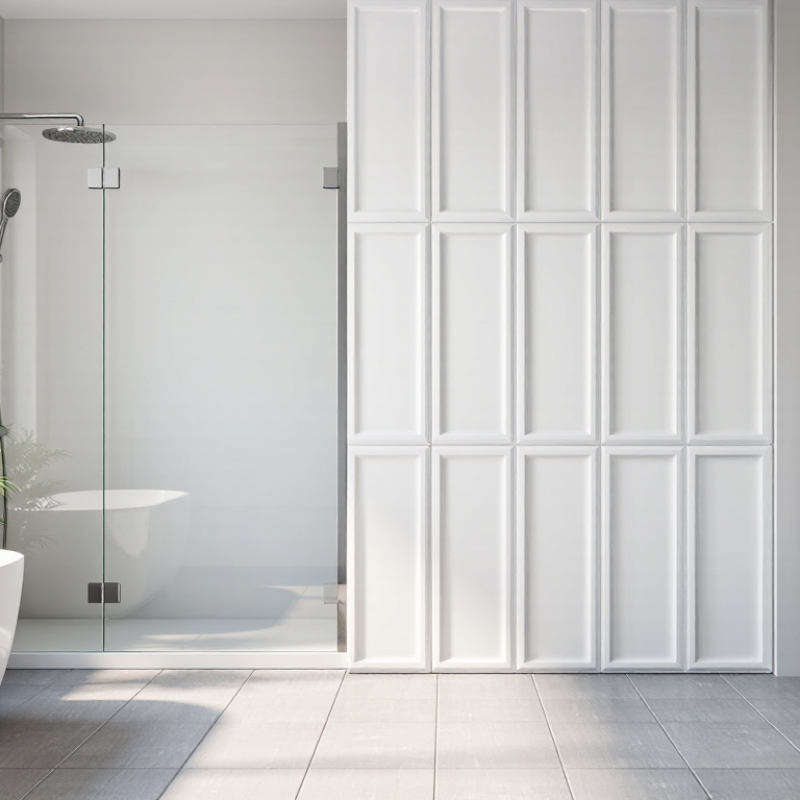
PVC bathroom panels are lightweight wall and ceiling boards made from polyvinyl chloride. They resist routine moisture and are easier to clean than painted plaster.
A typical panel has several layers: a decorative film, a protective surface, a rigid or foamed PVC core, and a rear backing layer. Many products use tongue-and-groove edges. These edges help create a neater surface, but they do not replace proper sealing around joints.
Several panel types suit different bathroom conditions. Hollow panels are light and easier to cut, while solid PVC sheets feel stronger and handle impact better. Foam-core panels add stiffness without much weight.
Some surfaces imitate marble, stone, timber, or simple tile patterns. Glossy finishes reflect more light, but they can show water marks quickly. Textured finishes hide small stains better. Choose carefully.
Common dimensions include lengths from 2,500 to 3,000 millimetres, widths of 250, 300, or 600 millimetres, and thicknesses of about 5 to 10 millimetres. Actual sizes vary by supplier and production method. Measure the wall twice.
A 600-millimetre panel can reduce seams, yet it may be awkward around a narrow shower corner. Panels are moisture-resistant, not magically watertight. Seal penetrations, corners, and floor connections with suitable bathroom sealant.
I would also inspect the wall behind them, because covering damp damage only hides the problem.
What Is PVC Panel for Bathrooms and Why Buy It?
Water Resistance Explained: PVC Absorption Is Typically ≤0.5% Under ASTM D570
PVC bathroom panels are rigid sheets made from polyvinyl chloride. They cover walls near showers, sinks, and bathtubs. Their main advantage is low water uptake. In professional ASTM D570 test reports, many PVC formulations show absorption at or below 0.5% after immersion. This figure helps explain their resistance to swelling, peeling, and repeated splashes. However, ASTM D570 is a test method, not a universal performance guarantee. Results depend on thickness, additives, temperature, and testing time. ISO 62 also measures plastic water absorption, allowing technical teams to compare materials more consistently.
In practical installation work, a panel can remain stable beside a steamy shower while grout lines collect dirt. That does not mean it is waterproof everywhere. Joints, corners, screw holes, and damaged edges still need careful sealing. The U.S. Green Building Council also emphasizes moisture management through proper detailing and ventilation. A useful panel should have a verified test report, clear installation instructions, and a surface that can be cleaned without harsh abrasion. I have seen attractive panels fail because installers trusted the sheet but ignored the joint.
Tips: Ask for the actual ASTM D570 result, including immersion time and specimen thickness. Check whether “≤0.5%” describes the finished panel, not only the raw resin. Seal every cut edge. Keep bathroom ventilation running after hot showers. Testing data matters, but workmanship still decides the wall’s long-term behavior.
PVC panels for bathrooms are valued because their dense, low-absorption surface leaves fewer places for water and dirt to hide. That matters around showers, sinks, and floor-level splash zones. The U.S. Environmental Protection Agency recommends keeping indoor relative humidity between 30% and 50% to limit moisture problems. A panel cannot control humidity alone. Installation still matters.
Cleaning is usually practical. A soft cloth, mild detergent, and clean water can remove soap film without rough scrubbing. Dry the joints afterward. Mold often begins where moisture remains trapped, especially around poorly sealed edges. The Centers for Disease Control and Prevention advises removing visible mold and correcting the moisture source. That advice is easy to overlook. PVC may resist water, but it is not maintenance-free.
Fire performance also needs careful wording. ASTM E84 evaluates surface burning characteristics, including flame spread and smoke developed, inside a controlled 24-foot tunnel. Its results help compare building materials, but they do not make a panel fireproof. Ask for current test documentation, product thickness, and installation conditions. A responsible specification should match the tested assembly, not just quote a number. In practice, that detail can be inconvenient, yet it prevents false confidence.
Hygiene and Safety: Surface Cleaning, Mold Control, and ASTM E84 Fire Testing
A smooth, non-absorbent panel surface can simplify routine wiping. Use cleaning products approved for the specific panel and follow the manufacturer’s instructions.
PVC itself does not provide a complete mold-control system. Proper sealing, ventilation, drainage, and moisture management are essential in bathrooms.
ASTM E84 evaluates surface flame spread and smoke development under a specific test method. Verify the tested assembly and report before purchasing.
What Is PVC Panel for Bathrooms and Why Buy It?
PVC bathroom panels offer a light, water-resistant surface with fewer grout lines than ceramic tile. Their value depends less on appearance than on installation discipline. Panel thickness should match the product specification and wall movement. In practice, 5–8 mm panels provide useful rigidity for many wall applications, but thicker is not automatically better. A poorly supported thick panel can still flex.
The substrate must be clean, dry, and reasonably flat. A practical site benchmark is about 3 mm variation over 2 metres, although the installation guide should control. Uneven walls create hollow spots, visible waves, and stressed joints. Correct them before fixing panels. Leave suitable movement gaps at corners and edges. Seal joints with a bathroom-rated, flexible sealant, especially around showers, pipes, and the floor line. Sealant is not a substitute for poor alignment.
Ventilation protects the wall system and the room. ASHRAE Standard 62.2-2022 identifies 50 cubic feet per minute for intermittent bathroom exhaust, or 20 cubic feet per minute for continuous operation. The U.S. Environmental Protection Agency recommends indoor relative humidity between 30% and 50% to reduce moisture problems. Run the fan during bathing and for a while afterward. Small details matter. A sealed panel can still trap moisture behind it if the substrate is damp. That risk is easy to underestimate, and installation practice is not always perfect. Periodic checks around joints remain sensible.
PVC bathroom panels PVC bathroom panels are rigid, water-resistant boards used on walls and ceilings. They create fewer joints than ceramic tiles, so soap residue and mildew have fewer places to collect. In practical use, a soft cloth and mild cleaner often handle daily marks. That saves time, but not every stain disappears easily. Strong solvents may damage the surface.
Thermal performance also supports their value. CIBSE Guide A lists unplasticised PVC near 0.17 W/m·K, although the exact figure changes with formulation, temperature, and panel density. This is far lower than many mineral-based wall materials. However, a thin panel is not a replacement for full insulation. The substrate, air gaps, and sealed joints still control much of the bathroom’s comfort. Small details matter.
Cost value comes from installation and long-term upkeep. The International Organization for Standardization’s ISO 15686-5 framework recommends comparing whole-life costs, not only purchase prices. PVC panels can reduce grout work, drying time, and repainting needs. Their large formats may also shorten installation. Still, cheap panels can scratch, fade, or flex around uneven walls. Checking thickness, fire classification, surface warranty, and installation instructions is sensible. A lower invoice is not always a lower lifetime cost.